|
July 4, 2021 / 418.33 ppm of atmospheric CO2 (safe level 350) $$PLAIN_TEXT_PREVIEW$$
|
The entire span of human life exists within each one of us, going all the way back to the hands of the creator. In our bodies, we carry the blood of our ancestors and the seeds of the future generations.
We are the living conduit of life.
~Sherri Mitchell (Sacred Instructions)
|
Developing a Larger View of Time- Cultivating Timefulness
|
|
I was recently in a meeting in which everyone was asked to introduce themselves like this:
|
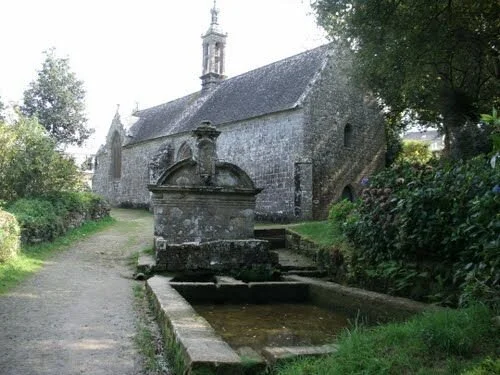
"My name is Anne-Marie, I am the daughter of Robert and Paulette. I was born in Brittany, France. Robert is the son of Marie and Pierre. Marie left school at 12 years old. She was very proud that she could read and write, and taught me the alphabet when I was 3 years old. My paternal grand-father Pierre, through an accident at birth, had lost the full use of his right arm, and as a result could not work at the farm like his ten other siblings. He was therefore allowed to go to school longer than his siblings and peers. I remember him telling me of being punished and humiliated at school if he spoke any word of Breton (Breton belongs to the celtic language family). He started the textile family business with his wife Marie: he was the salesperson while my grandmother was manufacturing the garments. It grew to employ 100 people in the 70's. On my mother side, Paulette is daughter of Francine and Louis. They owned a farm with a water mill and a bakery. He was sent to a forced labor camp during World War II, escaped, walked his way back home traversing France from East to West, was kept hidden in his own attic by his wife for over 18 months and died of cancer, shortly after the end of the war. After his death, Francine raised three daughters while still running the business. I only know of my maternal great grandmother who was a lavandière, i.e. she was washing other people clothes in a lavoir, a communal washing place, usually fed by a source of spring or other source water".
|
|
This happened in one of my Active Hope book study circles: at the time we were reading the chapters in the section titled Seeing with New Eyes where the authors, Joanna Macy and Chris Johnstone, invite us to widen our sense of self, to create a new story of power, to reinvent our communities, and to develop a larger view of time. Introducing ourselves this way had the (paradoxal) effect of deeply grounding us in the present moment, uncovering the large diversity of people in the room and evoking an enormous sense of gratitude for our ancestry.
Macy and Johnstone are not the only ones inviting us to revisit our sense of time by acknowledging our ancestors in order to envision a better future for our planet. Sherri Mitchell, a Native American attorney, teacher, activist, and change maker, author of Sacred Instructions- Indigenous Wisdom for Living a Spirit-Based Change, tells us that we have the responsibility to “dream the next seven generations into being”. In All We Can Save- Truth, Courage, and Solutions for the Climate Crisis, an anthology of essays by women at the forefront of the climate movement, she writes:
|
For us [Indigenous People], time does not exist as separate epochs unfolding in linear fashion, but as one movement unfolding in all directions simultaneously. We realize we cannot separate ourselves from those who have come before us or those who will follow, because we all exist together in this moment. Our sense of responsibility for the coming generations is reflected in this awareness.
|
|
Similarly, in his book On Time and Water, Andri Snær Magnason -an author I keep coming back to, also wants to update our sense of time: he reminds us of the concept of Cathedral Thinking (a concept also mentioned by Greta Thunberg in her April 2019 speech in front of the EU Parliament). Magnason defines Cathedral Thinking as the “ability to plan thirty, forty, fifty, one hundred years in the future: when one generation starts half of a cathedral, expecting the next generations to finish it in the next 300 years”. In Active Hope, other examples of long-term thinking are provided: when New College at Oxford University was founded in 1379, huge oak timbers were used to hold the roof of its dining hall. To provide replacement timbers, the college foresters planted a grove of oaks that would take several hundred years for the trees to grow to the right size. The foresters were thinking ahead in a time frame of centuries. Other examples of Cathedral Thinking include the construction of Angkor Wat (over more than four centuries) or Stonehenge (fifteen hundred years). The people involved in these projects clearly had accepted the fact that they would not see the impact of their work in their lifetimes, or even the lifetimes of their children or grandchildren. (This is also what Joanna Macy calls the gifts of uncertainty in her 2009 Bioneers address: engaging in action without any attachment to the results).
|
|
Taking even a wider view of time, Marcia Bjornerud, a geologist and writer, has authored a beautiful book titled Timefulness- How Thinking Like a Geologist Can Save the World. She defines timefulness as follows:
|
‘Timefulness’ is a clear-eyed view of our place in Time, both the past that came long before us and the future that will elapse without us.
|
|
She invites us to think like a rock or a mountain, to notice that as humans in this Anthropocene era, we are on par with volcanoes and rivers -which is also the point that Magnason was making in his Atlantic article The Gods Were Right measuring CO2 emissions in terms of volcanoes’ eruptions (see June newsletter). Borjnerud and Magnason both write about how we’re moving in a different speed of time now, how geological time has started moving at the speed of human time and how our denial of that fact is leading to climate inaction.
I have noticed other terms reflecting the same concept of widening our timescape, for example from the Long Time Project:
- long-termism: the ability to predict, forecast and plan for the future, and
- long-timism: the cultivation of an attitude of care for the world beyond our lifetimes
No matter what terms we use - Seventh Generation Concept, -Deep Time, -Cathedral Thinking, -Timefulness, -Long-Termism or -Long-Timism, adopting a broader timescape than our human centered view can have benefits for the planet and the future generations. Quoting Marciai Bjornerud again:
|
If widely adopted, an attitude of timefulness could transform our relationships with nature, our fellow humans, and ourselves. Recoginizing that our personal and cultural stories have always been embedded in a larger, longer -and still elapsing- Earth stories might save us from environmental hubris. We might learn to place less value on novelty and disruption, and develop respect for durability and resilience. Understanding how historical happenstance is written into each of our personal lives might cause us to treat each other with more empathy. And a timeful, polytemporal worldview might even make us less neurotic about the fact of our own mortality by shifting our focus from the finite length of our life to the rich anthology of experiences that a lifetime represents. While other senses may be dulled with age, the sense of time -which can be developed only by experiencing it - is heightened. Understanding how things have come to be the way they are, what has perished, and what has persisted makes it easier to recognize the difference between the ephemeral and the eternal. Growing old requires one to shed the illusion that there is only one version of the world.
|
|
So…
How would it be to start your next meeting or event with introducing yourself through your ancestors? How might you also acknowledge the future by having a short statement to recognize future generations such as, for example“As we start this meeting, we acknowledge the world that will exist beyond our life times and the people, animals and nature that will thrive in it”? What might these rituals shift in the way participants interact in that event or the decisions made in that meeting? How can you dream the future generations into being? I have captured the timefulness resources and practices mentioned in this essay on a page on my website (and additional ones that I did not write about here: check out this Deep Time Walk app for example) and will continue to add to the page regularly. Please share your own ancestors story as well as any timefulness practices or rituals that you may already engage in. You can reply to this post or comment in the blog section of the website.
Warmly, Anne-Marie
July 9, 2021 / 418.33 ppm of atmospheric CO2 (safe level 350 ppm)
|
Poem: Hieroglyphic Stairway by Drew Dellinger
|
|
Fri, Jul 02
it's 3:23 in the morning
and I'm awake
because my great great grandchildren
won't let me sleep |
|
|
|
|
|
Fall Women’s Pilgrimage in Japan- Only Three Spots Left
|
|
I am still accepting applications for the Kumano Kodo Women’s Pilgrimage Walking the Sacred Paths of Ancient Japan- A Pilgrimage for Women. If you are interested, please review the information below. You can read about the trip with this page. Day by day itinerary is available here. And the application process starts here.
I look forward to welcoming you on this amazing journey of transformation!
|
|
|
|
|
|
|
|
|