

Matsuri No Ato- A Reflection at the End of My Pilgrimage
I have been home for over a month now, having returned from Japan after completing the Shikoku 88 temple pilgrimage, and I am finding myself in a hero’s lull or a matsuri no ato moment.
This is a moment after completion of a meaningful project when energy drops, motivation thins, and what was meant to feel like arrival feels strangely flat. In Japanese culture, this moment has a name: matsuri no ato, literally “after the festival.” In the Hero’s journey, it’s called the Hero’s Lull that follows the quest. In psychology, it’s sometimes referred to as “completion depression”.
Have you ever encountered such a moment and feeling?
On November 12, I visited Temple 28 on the Shikoku 88 temple pilgrimage, completing the journey I had started in 2016. It took me four trips to the island of Shikoku (in 2016, 2023, 2024, and 2025) to visit all of the 88 temples, roughly twenty on each trip, visiting some more than once.
This matsuri no ato moment I am finding myself in, describes the quiet that settles once a festival ends, lanterns are taken down, crowds have dispersed, streets have returned to ordinary rhythm. The celebration was real and meaningful, and precisely because of that, its ending leaves a noticeable stillness behind. If you have attended any matsuri or festival in Japan, you can understand the profound meaning of the term.
However, matsuri no ato is not a problem to fix. It is a natural emotional phase: my nervous system is settling, my mind reorganizes after intensity, the identities I had left behind return, not quite fitting anymore. The emptiness or boredom is not evidence that something went wrong—it is actually evidence that something truly mattered. It’s a natural pause that deserves acknowledgement before the next rhythm of life begins.
Similarly, using the stages of the Hero’s journey, the Hero’s Lull comes when the quest is completed, the dragon is defeated, the treasure is secured. During the quest, purpose is supplied externally by danger, challenge, and necessity. Once that forward pull disappears, the nervous system downshifts, and the psyche must reorganize without the scaffolding of urgency and survival. The lull is a threshold for transformation, a time to reflect on who we have become in the course of the journey. Modern culture often skips this chapter of integration, rushing straight to the next goal.
As a coach, I know this, and yet, I have to work hard to resist jumping onto another goal or project, skipping over this integration phase. So I am taking my own medicine and reflecting.
Using the metaphor of matsuri no ato, here are the reflection prompts I am using to stay in this liminal phase a little longer:
What part of me was most alive during this “festival”—beyond outcomes or tasks?
What am I missing now: the goal itself, the structure it provided, or the version of myself it called forth?
If this quiet could speak, what would it name?
The festival does not end so that something better can begin—it ends so that something different can take shape. The next direction will emerge naturally, once the stillness has been honored.
That is what the coach in me says: Pause. Breathe. Acknowledge.
Once the feeling has been acknowledged, the bridge is not “What’s the next goal?” but “What wants continuity?” and “What doesn’t?”.
Let me know how this lands with you and if you have ever been in a hero’s lull.
Last of 88- Dainichiji Temple, Noichi
This is the last temple that I visited on the Shikoku 88 temple pilgrimage completing the journey I started in April 2016. That day I saw two other pilgrims. It was very quiet, almost too quiet.
This temple (#28), as many others on the pilgrimage, is dedicated to Dainichi Nyorai which I have encountered many times on my journey. It’s also named after the deity. Dainichi Nyorai is considered to be the greatest Nyorai, one of the thirteen enlightened beings or deities that are represented in Shingon buddhism.
(Inside the main hall of each temple site, there is a statue of the deity which is considered to be the central religious figure of each site).
One specific encounter with Dainichi Nyorai for me happened at a special ceremony on Mount Koya in early October called Kechien Kanjo: Kechien means "to form a connection" and Kanjo means "anointment" or "initiation."
This ceremony is usually reserved for monks during advanced training, but at Mount Koya, anyone can participate. During the ceremony, participants are blindfolded and guided in front of a mandala, which is a symbolic map of the Buddhist universe. They are asked to throw a flower onto the mandala. The spot where the flower lands shows which Buddha they are now spiritually connected with. My flower landed on Dainichi Nyorai.
During the two-hour ritual, together with hundreds of other blind folded pilgrims, I was guided into the Kondo Hall as we recited repeatedly “Namu Daishi Henjo Kongo”, the mantra of Kobi Daishi, the saint who founded Shigon buddhism in Japan and the 88 temple pilgrimage in the eight century. We also chanted the Dainichi Nyorai’s mantra: “Om, Abira unken, bazara dadoban”.
The point of the Kechien Kanjo ceremony is to lead you to realize that you are the Dainichi Nyorai yourself.
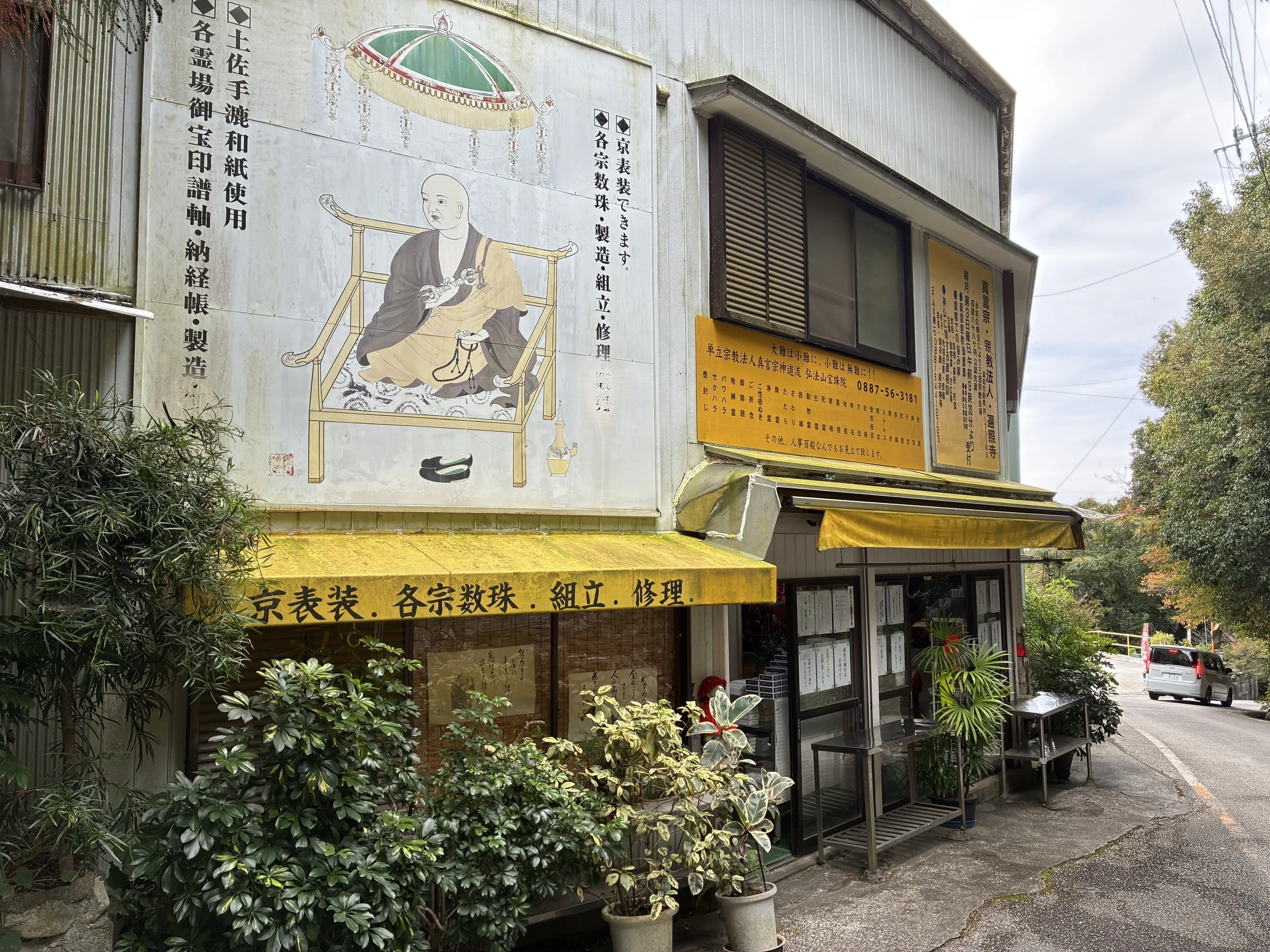
There was a shop at the bottom of Temple 28. To keep the connection alive and to return with a memento of that day, I bought a bracelet with a pearl through which a picture of Dainichi Nyorai can be seen. I shared my accomplishment with the woman at the store. She congratulated me. I thanked her for celebrating me and I left.
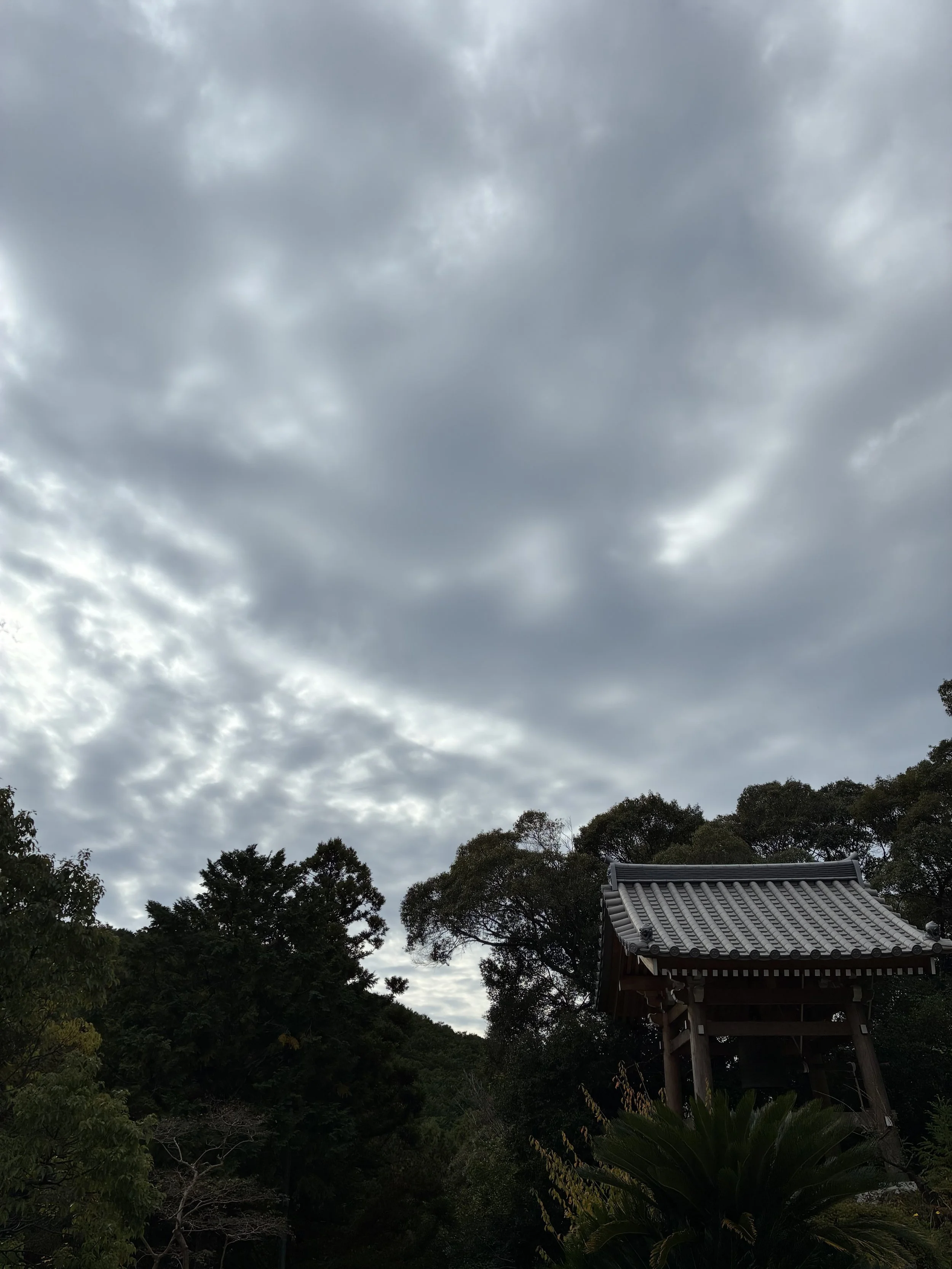
SKY ABOVE
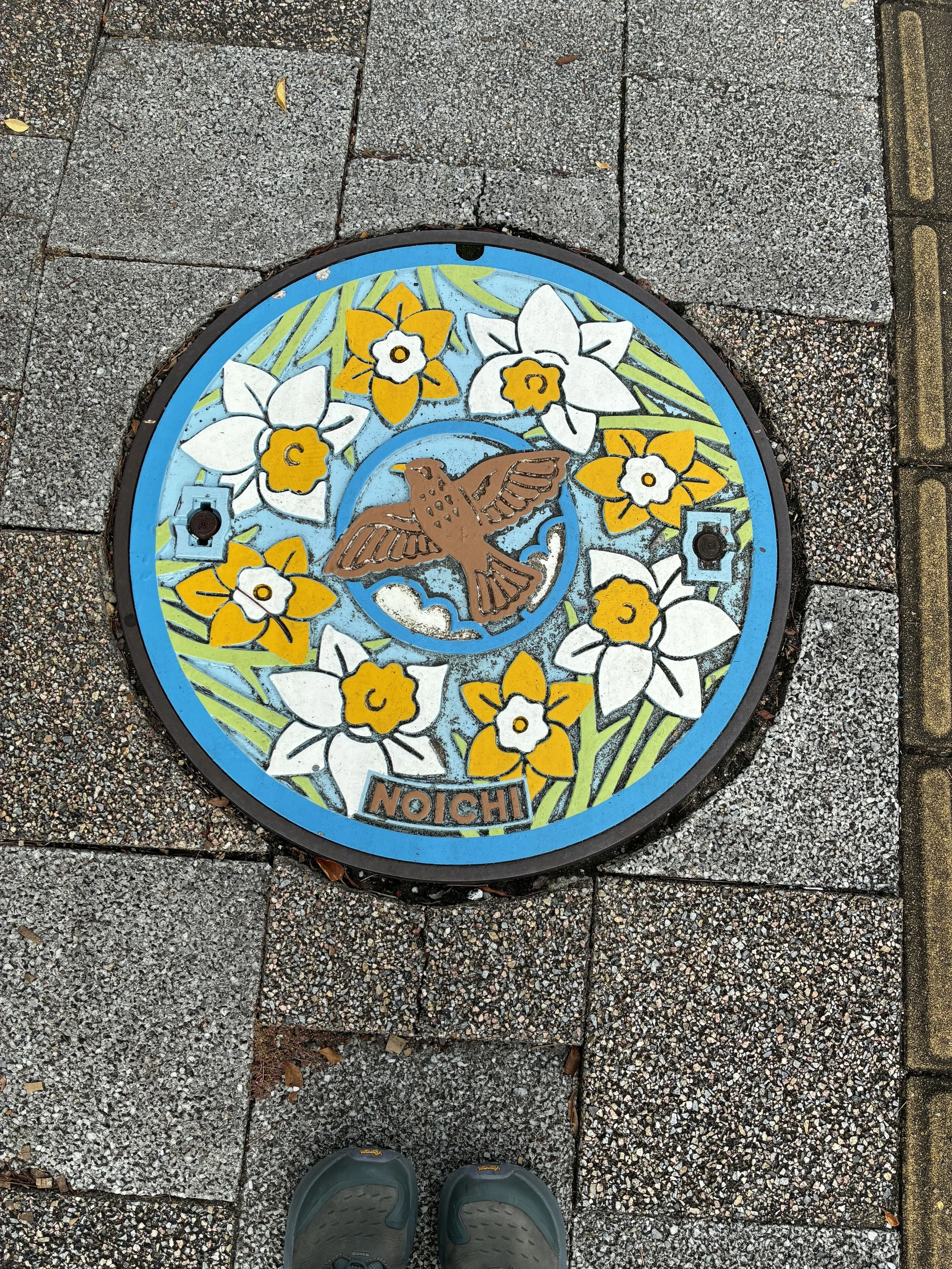
EARTH BELOW
kizukis

Happy Holidays! Is 2020 the Year You Will Go on a Pilgrimage?
2019 December Newsletter- Beginning Again: Walking Down the Path of Renewal
2019 September Newsletter- Is Wilderness Calling?
2019 August Newsletter- Why Pilgrimages Now?
The Nature Pyramid: Are You Getting Your Recommended Doses?

The Pyramid, called The SHIFT Rx Challenge Pyramid was informed by Florence Williams’ research in her book The Nature Fix, as well as Tanya Denkla-Cobb/the Biophilic Cities Project’s “Nature Pyramid.” The SHIFT Rx Challenge Pyramid indicates optimal “doses” of nature. From daily micro-doses that can range from exposure to daylight and plant life multiple times per day to annual multi-day excursions into wilderness areas where people can disconnect from technology, the Pyramid offers recommendations for duration as well as location of nature contact.
“Time spent outside in nature is good for us,” said Christian Beckwith, Executive Director of The Center for Jackson Hole, SHIFT’s parent organization. “In an age when the average American child spends seven hours per day in front of screens and seven minutes in unstructured play outside; rising obesity rates add billions of dollars to health care costs; opioid addictions outpace car accidents as the leading cause of death; and the growing disconnect from nature, particularly in our urban areas, leads to stress, depression and increased levels of mental anxiety in our citizens, time outside has never been more important.”
Do you need help getting your recommended doses? I have the following offerings:
Women’s Pilgrimage in the annually/bi-annually category
Wise Women Walk in the monthly category
Custom Contemplative Walk in the “anytime” category
I also offer the following coaching while walking programs:
I hope to see you on one of those. Anne-Marie